
Herbal Tea OEM Processing: Blending, Cutting, Sterilisation and Drying Route Selection
Herbal tea is often assumed to be nothing more than cutting botanicals and filling bags. On the plant floor the difficulty concentrates in two places: bringing microbial counts inside specification without flattening the aroma, and holding liquor colour, aroma and taste consistent from batch to batch. Those two constraints determine the process route, not a list of available machines. This article works through preparation, blending, cutting, sterilisation and drying.
1. Raw material preparation: consistency starts at sorting
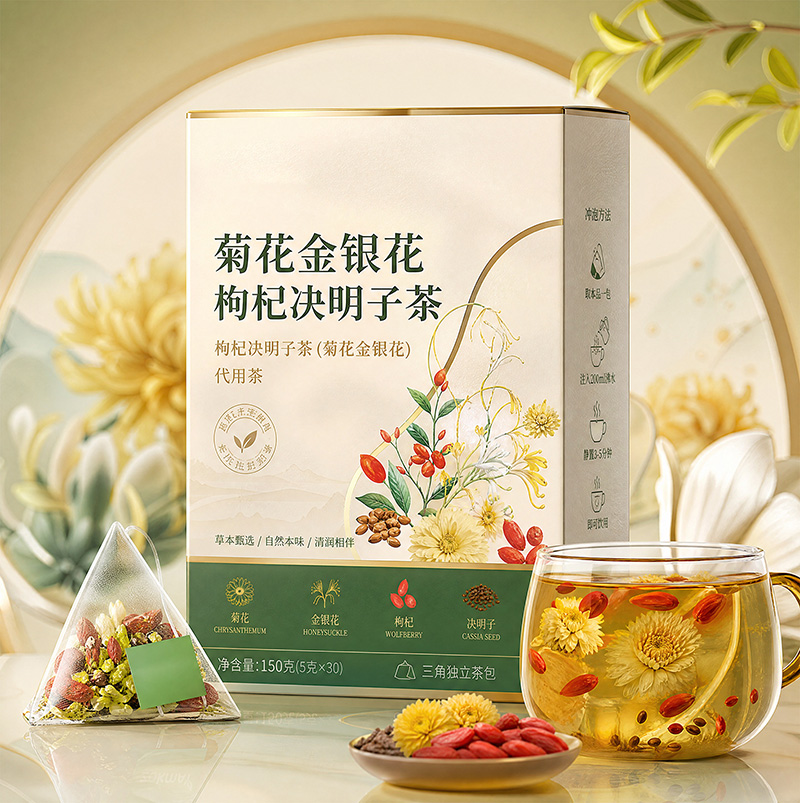
Flowers, leaves, fruits and roots behave very differently and each needs its own preparation route. Flowers such as chrysanthemum, rose and honeysuckle need screening to remove fines and receptacles and any discoloured petals that would dull the liquor. Fruits such as goji, hawthorn and cassia seed need size grading so that every sachet holds a comparable mix. Roots and rhizomes such as liquorice and astragalus need washing, conditioning and slicing, and slice thickness drives both drying rate and extraction speed.
Foreign matter control sits in the same stage - stones, metal, hair and insect damage. The usual configuration is a combination of air classification, magnetic separation, colour sorting and manual picking, scaled to the grade and volume. Shortcuts here cannot be compensated for later, however thorough the sterilisation step.
2. Blending: uniformity fails more often than formulation does
Most herbal teas are multi-ingredient, and the goal of blending is not simply mixing but making every sachet identical. The difficulty is physical: ingredients differ in particle size, density and flow behaviour, so blends segregate readily - petals float to the top, dense fruit pieces sink.
Four controls help. Keep the participating materials within a similar particle size band. Choose the mixer for the job: multi-directional motion mixers are gentler on delicate flowers, while V-blenders handle large density differences better. Watch fill level and mixing time, since overfilling and over-mixing both work against you. And pre-blend minor components with a portion of the bulk ingredient before the main blend.
The practical way to verify uniformity is to sample from several positions after blending - top, middle, bottom and corners - and compare component ratios. This belongs in the sampling stage and should become a standing instruction for production.
3. Particle size: it sets extraction, colour and mouthfeel together
Particle size is the most neglected parameter in herbal tea, and it governs three outcomes at once. Finer material extracts faster and gives a deeper liquor, but clouds the cup and leaves sediment. Coarser material gives a clean, bright cup but under-extracts within a normal brewing time.
The standard approach is staged cutting with classification: coarse crush first, then sieve to isolate the target band, return oversize for further cutting and downgrade or sell off the fines. Pyramid bags can carry larger leaf and benefit visually from a coarser cut; flat filter bags generally need a finer cut to brew quickly enough.

4. Sterilisation: the aroma trade-off is unavoidable
Botanical raw materials carry substantial environmental microbial loads, while product standards set limits for total plate count, coliforms and moulds, and some markets require absence of salmonella. Sterilisation is therefore mandatory, and every method has a cost.
Hot air treatment is cheap and simple but visibly damages aroma: volatile floral notes are lost at temperature and fruit pieces darken. Steam treatment is efficient and effective, but it adds moisture and must be paired with drying, or the result is caking and a mould risk.
Irradiation or electron beam has the least impact on flavour and colour and gives a thorough kill, which is why it is common in export programmes - but the destination market's position on irradiated foods has to be confirmed, since some restrict it or require mandatory labelling. Microwave treatment sits between the two, combining heating and microbial reduction, suits small to medium batches, and is sensitive to bed depth and moisture, with uniformity being the main challenge.
The selection rule is straightforward: measure the gap between the incoming load and the specification, and use the mildest treatment that closes it. Control moisture before sterilisation as well, because wetter material needs a harsher treatment for the same result and loses more aroma doing it.
5. Drying: the curve matters more than the endpoint
Drying is not only about reaching a safe moisture level, typically below 8 to 12 percent depending on the botanical, but about getting there without losing aroma or colour. Multi-stage variable-temperature drying usually beats single-stage high-temperature drying: a warmer first stage removes surface moisture quickly, a cooler middle stage lets internal moisture migrate outward, and a low-temperature finish preserves volatiles.
Do not overdry. Too little moisture makes leaves brittle, generates fines during packaging, lowers yield and clouds the infusion. Cooling before packing matters as much as drying: packing warm material creates condensation inside the bag, which is the single most common cause of mould complaints.
6. Freeze the process into a work instruction
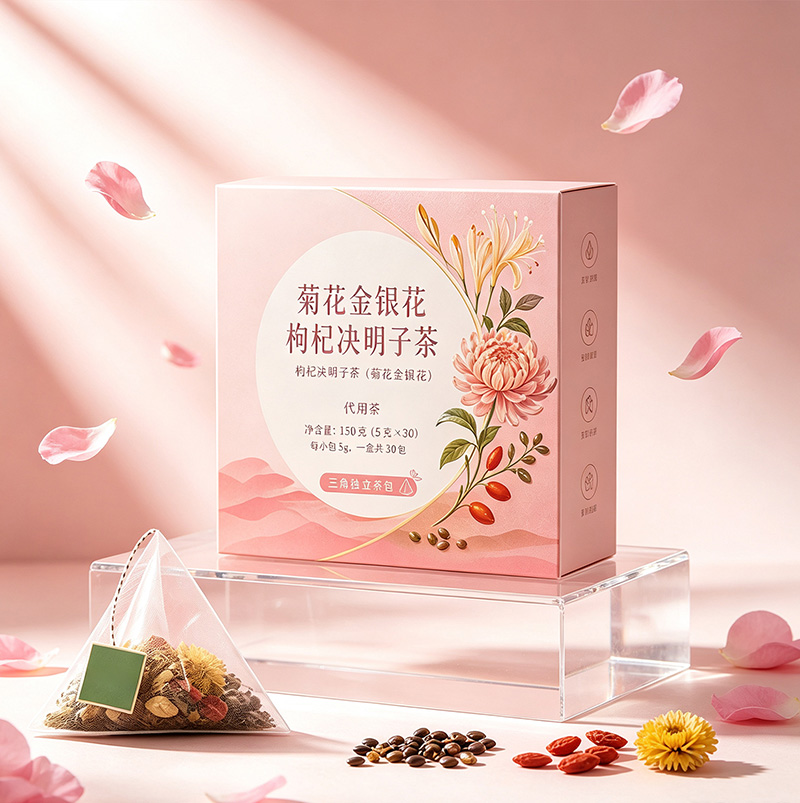
Finish sampling with a complete parameter sheet: preparation method and yield loss for each ingredient, blending order and time, particle size band and sieve specification, sterilisation method and intensity, the drying curve by stage with endpoint moisture, and cooling and packing room conditions. That sheet is what makes production repeatable, and it is the only reliable reference when quality drifts.
For brand owners, the right process in herbal tea OEM is not the most elaborate one. It is the combination of aroma, microbial safety and cost that can be reproduced every time - and anything that can be written into a work instruction is by definition reproducible.
Related Products
Grape Oolong Fruit Tea Blend | Pyramid Tea Bags Herbal Wellness Tea Custom OEM | Corn Silk Herbal Tea | Wellness Herbal Tea Private Label OEM Manufacturer
About Guangzhou Mesen Health Biotechnology Co., Ltd
Guangzhou Mesen Health Biotechnology Co., Ltd is located in the Huashan Science and Technology Park, Huadu District, Guangzhou. The company has focused on OEM and ODM services for the big health industry for nearly 20 years, operating dedicated research, production, sales and management centres, and maintaining long-term strategic partnerships with well-known Chinese medicine colleges and research institutions. Capabilities span pressed candy, gummies, capsules, solid beverages, herbal teas, plant beverages, protein powders, dietary supplements and enzyme jelly - from formulation development through contract manufacturing. For details on minimum order quantities, sampling lead times and quotations, see our manufacturing advantages and product range, or contact us for a tailored proposal.
Further Reading




