
Export Documentation for Nutraceutical OEM: Filings, Customs Registration and Market Access
What separates an export programme from a domestic one is not the product but the number of rule sets in play: production and export compliance at home, Chinese customs requirements for the shipment to leave, and the destination country's market access regime. These three tracks involve independent documents with different lead times, and a gap in any one of them stops the goods at the port or at destination. This article maps the three tracks and suggests how to plan around them.
1. Domestic production and export standing
The first track is the manufacturer's standing. The plant must hold a valid food production licence whose categories and sub-categories cover the format being produced - a mismatch here is the most basic compliance failure there is, and brand owners should ask for the licence and its annex and read them during supplier selection.
Export filing comes next. Food manufacturers exporting from China must complete the export food production enterprise filing and hold a filing number to act as the producer of exported product. The product's applied standard and label must also comply with Chinese rules, because the act of manufacturing is regulated domestically even when every unit ships abroad.
Those three checks - licence scope, export filing status and applied standard - belong before contract signature, and all three can be verified against publicly accessible regulator registers.
2. Customs and shipping documents
The second track covers what the shipment needs to clear. The routine set is contract, commercial invoice, packing list, customs declaration, the inspection and quarantine declaration filed under current requirements, and the transport document, being a bill of lading or waybill. Where inspection is required or a certificate has to be issued, that process runs alongside.
The items whose lead time is most often underestimated are official certificates. Health certificates are needed for customs clearance in a number of countries. Certificates of free sale, showing the product may be sold legally in its country of production, are standard for Southeast Asian and Middle Eastern markets. Certificates of origin support preferential duty claims, for example under the China-ASEAN arrangements. Each requires an application in advance, with processing times ranging from a few working days to several weeks, and some can only be issued once the relevant filing or inspection is complete.
Label requirements deserve separate attention. Most countries require the local official language or English, together with their own mandatory particulars. Non-compliant labelling means rework or rejection at clearance.
3. Destination market access: the widest variation
The third track varies most and causes the most trouble. By market type, the patterns look like this.
Southeast Asia generally requires registration or notification with the local food or drug authority, the name and procedure differing by country. Expect to supply formulation, process description, test reports and manufacturer qualification documents, and in many cases a certificate of free sale. Registration runs from several weeks to several months.
The Middle East typically requires labels in the local language with prescribed particulars, licences held by the importer, and religious compliance on ingredients such as gelatin source and any alcohol content. Halal certification is a practical necessity across most of the region and has to be issued by a recognised body.
Western markets have their own frameworks. The United States regulates dietary supplements under dedicated legislation: facilities must register and follow good manufacturing practice, labels must follow the supplement label format, and new dietary ingredients require advance notification. The European Union works from permitted ingredient lists and its own labelling rules, restricts additives such as titanium dioxide and sets contaminant limits, and requires nutrition and health claims to use approved wording.
4. Religious and speciality certification is not optional
In many markets halal and kosher certification is an entry condition rather than a differentiator. Both are audited by specialist bodies covering ingredient origin, equipment cleaning and supply chain traceability. Expect scrutiny of gelatin species, the source of glycerin and emulsifiers, and any contact with prohibited substances. Certification takes weeks to months and carries a fee.
Organic certification, non-GMO verification and third-party management system certificates such as HACCP, ISO 22000 or FSSC 22000 are rarely legal requirements, but large distributors and retail buyers routinely ask for them.
5. Plan backwards from the landing date
Work the schedule in reverse. For a typical Southeast Asian programme: destination registration takes 4 to 12 weeks depending on country and category; official certificates one to three weeks; production and testing two to four weeks; sea freight and clearance one to four weeks. Add those up and the interval between placing an order and having saleable goods in the destination market is commonly two to four months. If the project also involves formulation development, sampling and stability studies, add another one to three months in front of that.
6. Build one document pack
Assemble a single export pack covering company qualifications (production licence, export filing certificate, system certificates), product documents (formulation, process description, product standard, label artwork, test reports), trade documents (contract, invoice, packing list, certificate of origin, insurance policy) and compliance certificates (health certificate, certificate of free sale, halal or organic certification). Assign one owner to maintain it and review it before every shipment; it removes most of the last-minute scramble for missing papers.
For brand owners, the value of an OEM partner with export experience lies precisely here. It is rarely a question of production capability; it is familiarity with the document chain, where one missing certificate costs another week of freight and storage.
Related Products
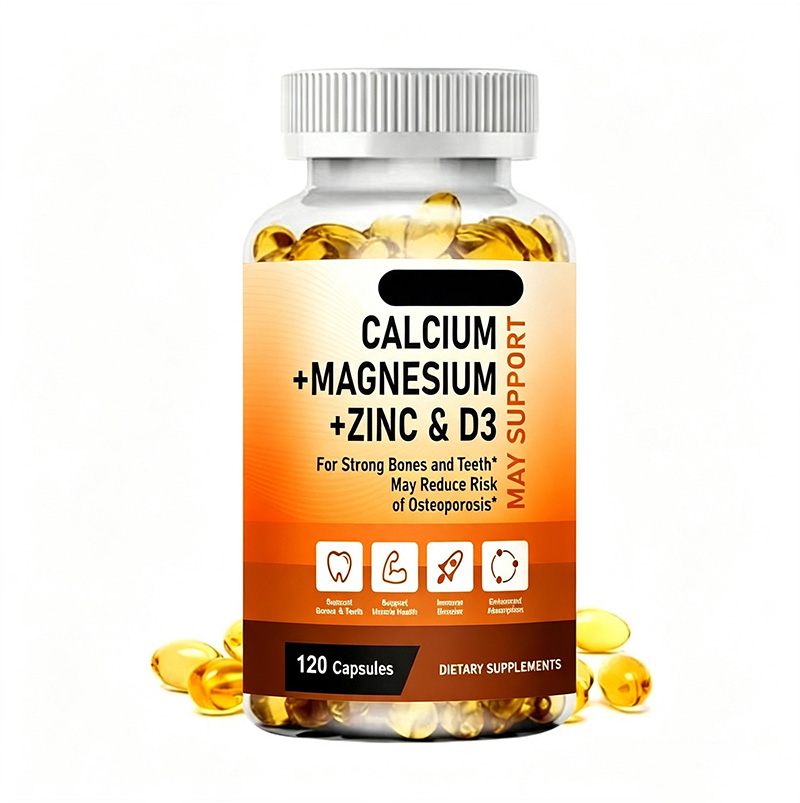
Vitamin D3 K2 with Magnesium & Zinc Softgels | VITAMIN D3+K2 MAGNESIUM+ZINC Softgels OEM | Calcium + Magnesium + Zinc + Vitamin D3 Softgels | CALCIUM+MAGNESIUM+ZINC D3 Softgel OEM
About Guangzhou Mesen Health Biotechnology Co., Ltd
Guangzhou Mesen Health Biotechnology Co., Ltd is located in the Huashan Science and Technology Park, Huadu District, Guangzhou. The company has focused on OEM and ODM services for the big health industry for nearly 20 years, operating dedicated research, production, sales and management centres, and maintaining long-term strategic partnerships with well-known Chinese medicine colleges and research institutions. Capabilities span pressed candy, gummies, capsules, solid beverages, herbal teas, plant beverages, protein powders, dietary supplements and enzyme jelly - from formulation development through contract manufacturing. For details on minimum order quantities, sampling lead times and quotations, see our manufacturing advantages and product range, or contact us for a tailored proposal.
Further Reading




