Herbal Tea OEM Warehouse: Pest Control and Stock Rotation Rules
Herbal tea raw materials are almost entirely dried plant matter - leaves, flowers, fruit, roots and stems. That fact shapes everything about storage. The material is at once a food ingredient and, from an insect point of view, both a meal and a habitat. In herbal tea contract manufacturing, the warehouse is the stretch customers never see and, all too often, the stretch where things go wrong. Leave a batch sitting for a few months in a poorly controlled room and insect damage, mould and aroma loss arrive together. By the time anyone notices at the point of dispensing, the loss is not just material but a production schedule already committed. This article looks at storage in operational detail: environment, racking, pest management and stock rotation.
1. Temperature and humidity are the first line
Dried botanicals are normally held at a low moisture content. If ambient humidity runs high, the material slowly takes on water; past a certain point, mould risk climbs quickly and aroma compounds volatilise or oxidise faster as well. Warehouses should therefore stay cool and dry, holding temperature in a stable low band and relative humidity below a defined ceiling, with dehumidification matched to the local climate. Fluctuation is more dangerous than a constant, slightly elevated temperature: day-night cycling condenses moisture on the material surface repeatedly, and this slow uptake often occurs before a moisture meter flags anything, while microbes are already active. Install temperature and humidity recording inside the store, ideally continuous with periodic manual readings, and keep the records so any anomaly can be traced to specific batches.
2. Hard requirements for the facility
A few facility rules are worth holding firmly. First, keep materials off the floor and away from walls, on racking or pallets, because walls and floors are the main pathways for moisture and pests. Second, choose racking that is easy to clean and hard for insects to colonise; timber absorbs moisture and cracks, creating harbourage, whereas metal or plastic performs better. Third, separate zones with clear labels and physical segregation for quarantine, released, rejected, returned and pending-disposition material, so status confusion cannot lead to misuse. Fourth, cover lighting to prevent glass falling into product and ventilate only in ways that do not import external moisture. Fifth, seal openings: insect mesh, air curtains and door sweeps look trivial but outperform chemical treatment after the fact.

3. Pest control is a system, not a spray
The mature approach is integrated pest management, built on prevention rather than reaction. The first layer is incoming control: inspect packaging integrity and check for eggs or live insects on receipt, and quarantine anything suspicious immediately rather than hoping for the best. The second is environmental control, using humidity management and cleaning programmes to remove the conditions pests need - corners, rack bases and the space behind equipment accumulate dust and residues and are favourite harbourage. The third is monitoring, with sticky traps placed and inspected on a schedule, concentrating on doors, windows, drains and corners, so that trends in catch counts are visible before adults are seen walking about. Only the fourth layer is treatment, whether chemical or physical, and it requires qualified operators, records and safety-interval management. The whole programme needs a pest trend chart, which is the most direct evidence an auditor will ask for.
4. FIFO and safety stock
No warehouse stays healthy if stock stops moving. The practical way to enforce first-in-first-out is batch labelling: every incoming lot is marked with receipt date and batch number, dispensing follows date order, and the batch used is recorded so traceability holds. Safety stock levels must account for procurement lead time, testing time, production variability and raw material seasonality. Herbal materials are strongly seasonal - some varieties are harvested only in particular months - so waiting until stock runs out means either nothing suitable is available or a higher price buys a poorer grade. For strongly seasonal items, build a sensible reserve at the end of the harvest window, while assessing whether that reserve will sit longer than its freshness allows, and if necessary extend usable life through packaging or store temperature.
5. Dealing with aged material
Every warehouse accumulates material that has sat for a while, and the rules for handling it should be written down. Quality should assess it first, covering moisture, sensory character, aroma, microbiology and safety indicators where relevant - not a glance and an opinion. Material that passes but has faded aroma can be used in formulas where aroma demands are lower, or blended with fresh material to balance flavour, provided the blend ratio is justified and a sample retained. Material that fails must be scrapped, however uncomfortable the cost pressure, and never allowed to flow into production. Records of these decisions are another focus during audits, because they reveal how well a factory really understands the condition of its own stock.
6. Bring the warehouse into the quality system
A warehouse is not logistics support; it is a link in the quality chain. Temperature and humidity records, stocktake records, pest monitoring, cleaning records and training records all belong in the system documentation, with internal checks and periodic trend review at management review. Warehouse staff should be trained on a schedule in material characteristics, cross-contamination prevention, pest identification and the escalation route. Once people can recognise problems, most of them are caught at the bud rather than on the production line. The investment is small and the return is direct.
Herbal tea storage is ultimately a negotiation with nature. Dried plant matter will change given the right humidity, temperature and insects. Hold the environment, keep stock moving and monitor honestly, and the material reaches the dispenser in the condition it arrived.
Related Products
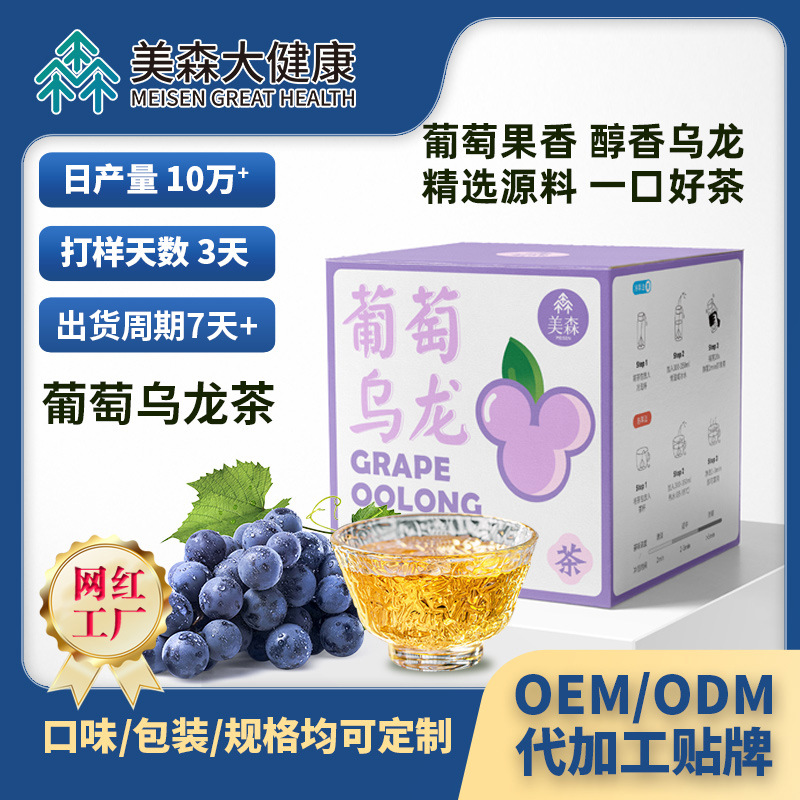
Grape Oolong Fruit Tea Blend | Pyramid Tea Bags Herbal Wellness Tea Custom OEM | Corn Silk Herbal Tea | Wellness Herbal Tea Private Label OEM Manufacturer
About Guangzhou Mesen Health Biotechnology Co., Ltd
Guangzhou Mesen Health Biotechnology Co., Ltd is located in the Huashan Science and Technology Park, Huadu District, Guangzhou. The company has focused on OEM and ODM services for the big health industry for nearly 20 years, operating dedicated research, production, sales and management centres, and maintaining long-term strategic partnerships with well-known Chinese medicine colleges and research institutions. Capabilities span pressed candy, gummies, capsules, solid beverages, herbal teas, plant beverages, protein powders, dietary supplements and enzyme jelly - from formulation development through contract manufacturing. For details on minimum order quantities, sampling lead times and quotations, see our manufacturing advantages and product range, or contact us for a tailored proposal.
Further Reading