Tablet Press Parameters in Pressed Candy OEM: Fill Depth, Compression and Weight Variation
Tablet compression looks like the most mechanical step in pressed candy manufacturing: powder goes in, tablets come out. In practice, it is where most sampling programmes quietly fail. The same formulation can produce tablets that pass hardness, friability, disintegration and weight variation on one press and fail three of them on another, purely because the set-up parameters were never treated as part of the recipe. This article works through the five parameter groups that actually matter - fill depth, pre-compression, main compression, turret speed and feeder dwell - and the sequence an experienced plant follows when weight variation shows up.

1. Fill depth: the primary determinant of tablet weight
Fill depth is the distance the lower punch travels down before the die cavity is levelled by the scraper blade. That cavity volume, multiplied by the bulk density of the granulation, is the tablet weight. Set-up normally works backwards: fix the target weight, calculate the cavity volume needed to deliver it, then adjust the fill cam until weighed tablets land on target.
The hidden assumption is that bulk density stays constant. It rarely does. A granulation carrying a higher fines fraction packs more tightly, so the same fill depth yields a heavier tablet. That is why fill depth is a per-batch parameter rather than a per-product one. Plants that run consistent output measure bulk and tapped density on every granulation batch and log the permitted adjustment window in the batch record. When the required correction falls outside that window, the fault is upstream in granulation, not at the press.
2. Pre-compression and main compression: the hardness triangle
Main compression force determines how tightly particles bond. More force gives higher hardness and lower friability, but pushes disintegration time out. Hardness, friability and disintegration form a triangle, and every formulation sits somewhere different inside it - no combination optimises all three at once.
Pre-compression exists to remove entrained air before the main event. Air that is not expelled gets compressed inside the tablet and then expands elastically as the tablet leaves the die, which is the classic mechanism behind capping and lamination. Formulations loaded with botanical extracts are especially vulnerable, because plant extracts are elastic and recover strongly after compression. A sensible starting point is pre-compression at 10-30% of main force, paired with a reduced turret speed that simply gives the air longer to escape.
3. Turret speed and feeder dwell: the invisible ceiling on output
As turret speed rises, the time each die spends under the feed frame falls. Below a certain dwell time the cavity is not fully filled, so tablets come out lighter and the spread widens. On a high-speed press this becomes the dominant constraint: pushing from a comfortable setting to the machine maximum can take weight variation from roughly 3% to 7% relative standard deviation.
Finding the ceiling is straightforward. Step the speed up in increments, pull twenty tablets at each setting, and plot the RSD. The point where the curve turns upward is the practical output limit for that formulation on that machine. Running just below it and making up volume with shift length is almost always cheaper than running flat out and rejecting product at the end of the line.
4. Weight variation: limits and a fixed diagnostic order
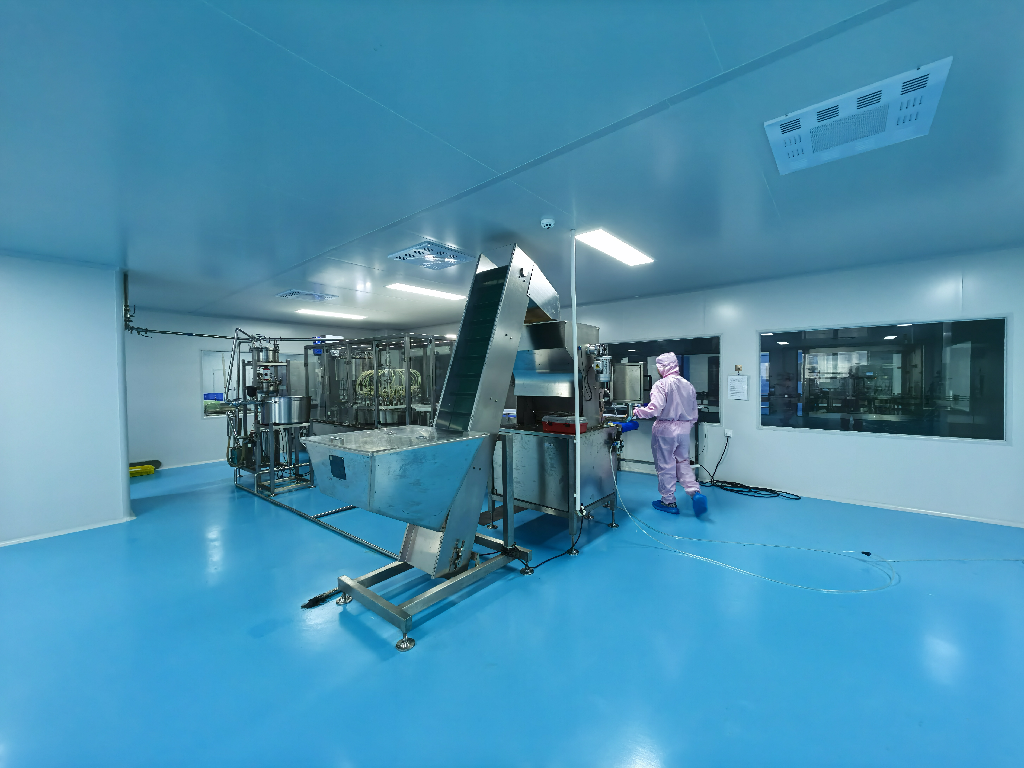
Pharmacopoeial practice is to weigh twenty tablets individually, calculate the mean, and allow no more than two outside the permitted deviation, with none exceeding twice that limit. Pressed candy sits in the general food category, so the standard is not mandatory - but competent pressed candy OEM plants apply it anyway, because weight variation is a proxy for content uniformity. A tablet that is eight per cent light is delivering eight per cent less of what the label promises.
The diagnostic order matters more than the test itself. Check granulation flow first (angle of repose, Carr index), then the feed system (hopper level, feeder speed, scraper wear), then fill depth and lower punch position, and only then touch compression force. Reaching for the force adjustment first is the most common mistake in compression: it rarely fixes weight, and it degrades friability while doing so.
5. Sticking and picking: a material problem wearing a parameter disguise
Sticking leaves a filmed, pitted tablet surface; picking lifts material clean out of the tablet face. Both are usually blamed on compression settings, and both are usually caused by something else entirely - granulation moisture above the working range (commonly 2-5%, formulation dependent), insufficient or poorly dispersed lubricant such as magnesium stearate or colloidal silica, worn or poorly polished punch faces, or simply excessive humidity in the compression room.
The response sequence is to measure moisture first, then verify lubricant level and blending time, then inspect tooling. Hygroscopic, sugar-rich formulations also need the room itself held in check: plants where compression runs above 60% relative humidity see sticking cluster through the summer months, and the fix there is environmental rather than mechanical.
6. The parameter set belongs in the process file
Once a trial run is approved, every setting - fill depth, pre- and main compression force, turret speed, feeder speed, room temperature and humidity range - should be written into the process instruction and the batch record. Without it, the next shift, the next operator and the next granulation batch each reinvent the set-up, and the approved trial stops being reproducible.
For brand owners there is a short test of a contract manufacturer's discipline: ask to see the compression parameter log from the previous batch. A plant that can produce it in ten minutes is a plant that can reproduce your product reliably. One that cannot will keep sending samples that look right in the box and behave differently once production starts.
Related Products
Glycerol diester coffee OEM OEM OEM OEM OEM meal replacement coffee MCT live broadcast same solid beverage source manufacturer | GLP-1 Semaglutide Satiety & Fat Blocker Tablets | Custom Pressed Candy OEM Manufacturing
About Guangzhou Mesen Health Biotechnology Co., Ltd
Guangzhou Mesen Health Biotechnology Co., Ltd is located in the Huashan Science and Technology Park, Huadu District, Guangzhou. The company has focused on OEM and ODM services for the big health industry for nearly 20 years, operating dedicated research, production, sales and management centres, and maintaining long-term strategic partnerships with well-known Chinese medicine colleges and research institutions. Capabilities span pressed candy, gummies, capsules, solid beverages, herbal teas, plant beverages, protein powders, dietary supplements and enzyme jelly - from formulation development through contract manufacturing. For details on minimum order quantities, sampling lead times and quotations, see our manufacturing advantages and product range, or contact us for a tailored proposal.
Further Reading